Over the past six weeks we’ve looked at how the ongoing drought is impacting local natural communities — from our high-elevation forests, to wildlife, to aquatic systems. Water is essential for every natural system, just as it is for our human communities. To conclude this series we’ll be looking at this drought relative to past droughts in Colorado, what conditions brought us to the present moment, and what information, if any, this drought tells us about future droughts. Finally, we’ll look at what action we can take to reduce the probability and impacts of droughts in the years ahead.
Drought in the Roaring Fork Valley
Anatomy of a Drought
To understand the current drought, it’s important to begin by defining the word drought. The National Weather Service defines drought as: “A deficiency of moisture that results in adverse impacts on people, animals, or vegetation over a sizable area.” The definition purposefully uses the term moisture instead of precipitation. Moisture captures both the amount of water entering a system from precipitation and the amount of water leaving a system either through runoff or evapotranspiration (the combination of water that evaporates from surface water and soil, and water that transpires from plants). When discussing droughts we are concerned with how much precipitation is entering a system, whether the precipitation is snow or rain, the intensity of precipitation (i.e. an intense thunderstorm vs. a day of steady rain), and how much water is leaving the system.
Our Current Drought and Historical Droughts
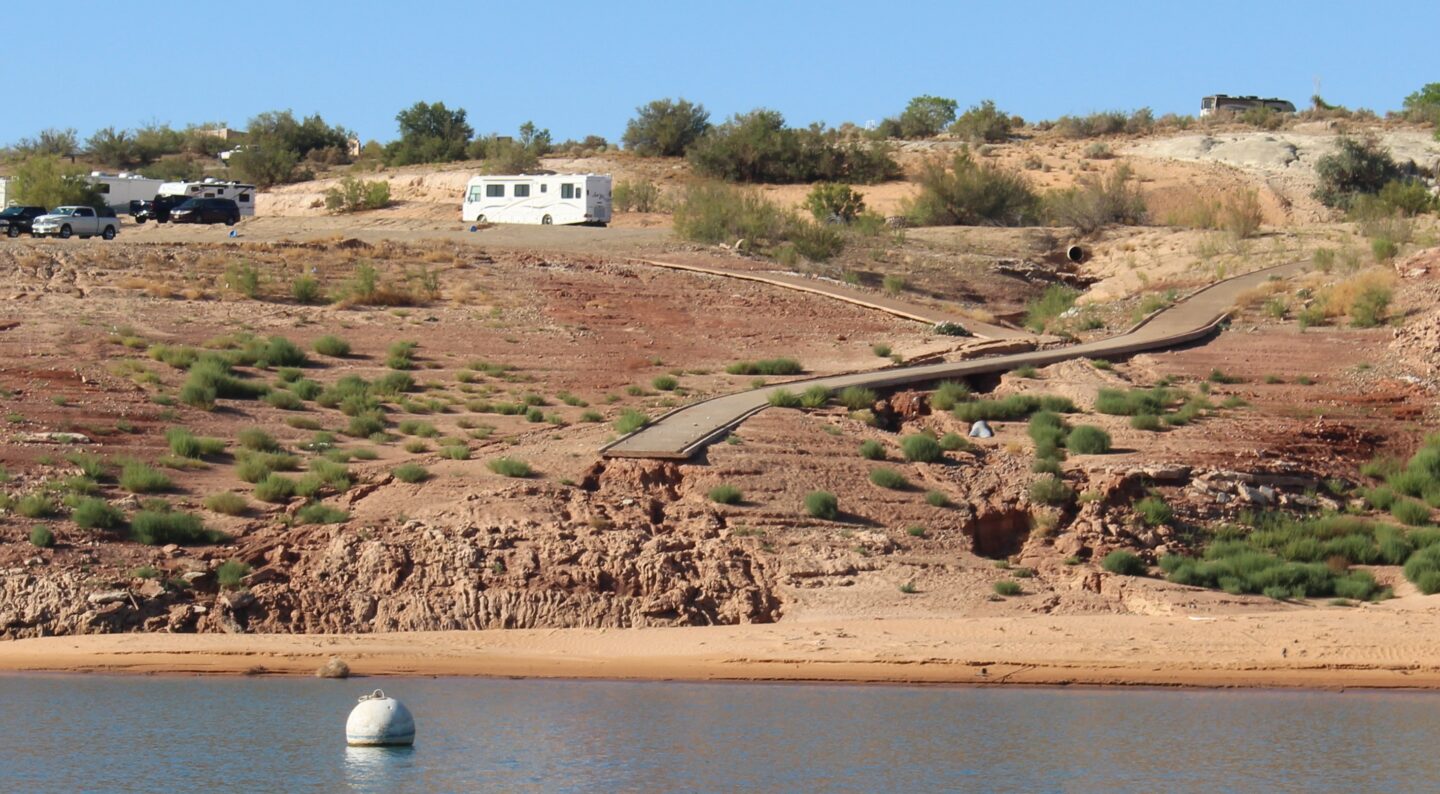
Our current drought is best understood at two timescales and through two climate phenomena: one operating at the scale of decades, the other at the scale of months. At the decadal scale, Colorado and the rest of the southwestern United States have been in a state of drought since 2000, often referred to as the Millennium Drought. We can see this in our reservoirs that are constantly on the brink of dead pool or in our forests that are besieged by constant fires and insects.
At the scale of months, we entered the current drought in February of 2025. The 2024–25 winter started in dramatic fashion: at the start of Thanksgiving week a massive snowstorm hit our valley, resulting in the watershed’s third-highest 24-hour precipitation event since 1979. Following this, the snowpack remained at average levels until late winter when precipitation dropped off. We ended the 2024–25 winter in the 21st percentile. The 2025 summer offered little relief, with precipitation ending in the 19th percentile.
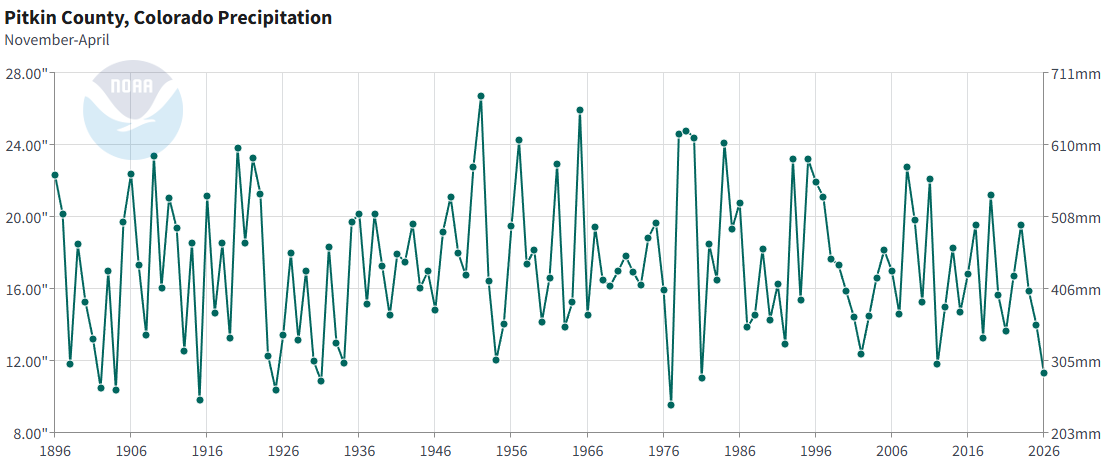
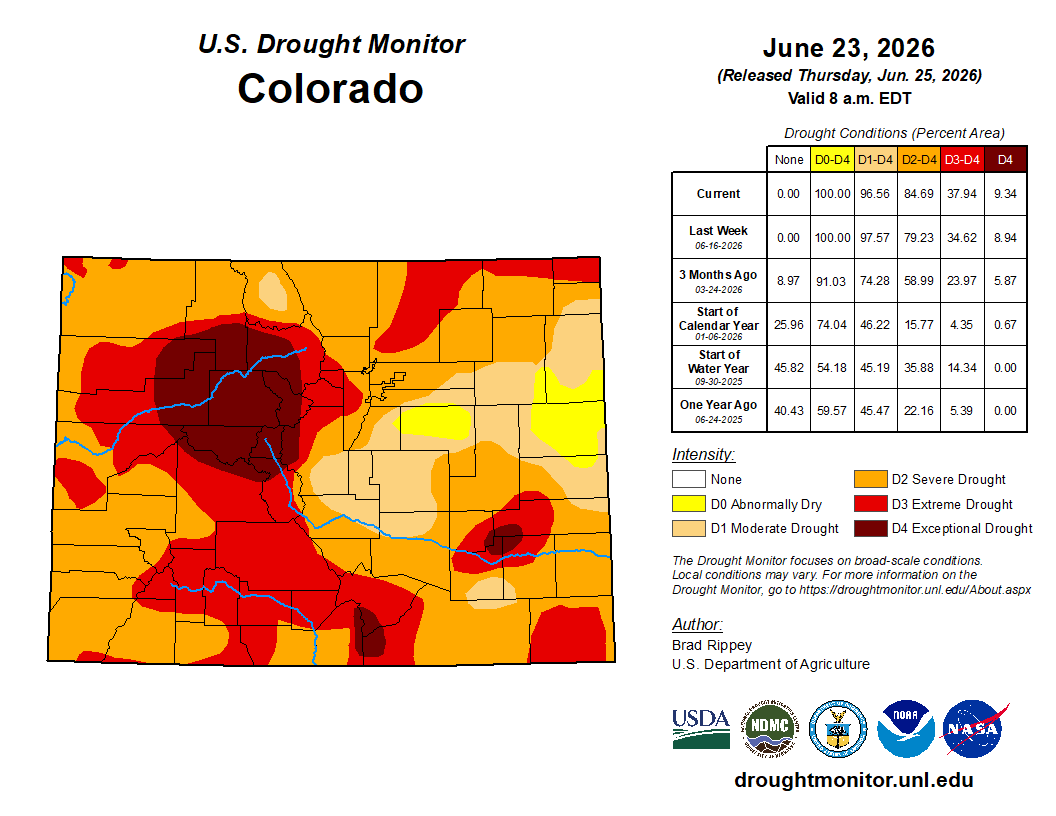
Over this time our drought status according to the US Drought Monitor steadily worsened, moving from Abnormally Dry in February 2025 to Extreme Drought in July 2025, the second-highest level of drought. At the end of December the first portion of the Roaring Fork Watershed entered the US Drought Monitor’s highest level of drought, Exceptional Drought. By April 1, 2026, the entire watershed was in a state of Exceptional Drought, which persists until today. Precipitation for the 2025–2026 winter ended in the 6th percentile — the 8th driest winter since 1895.
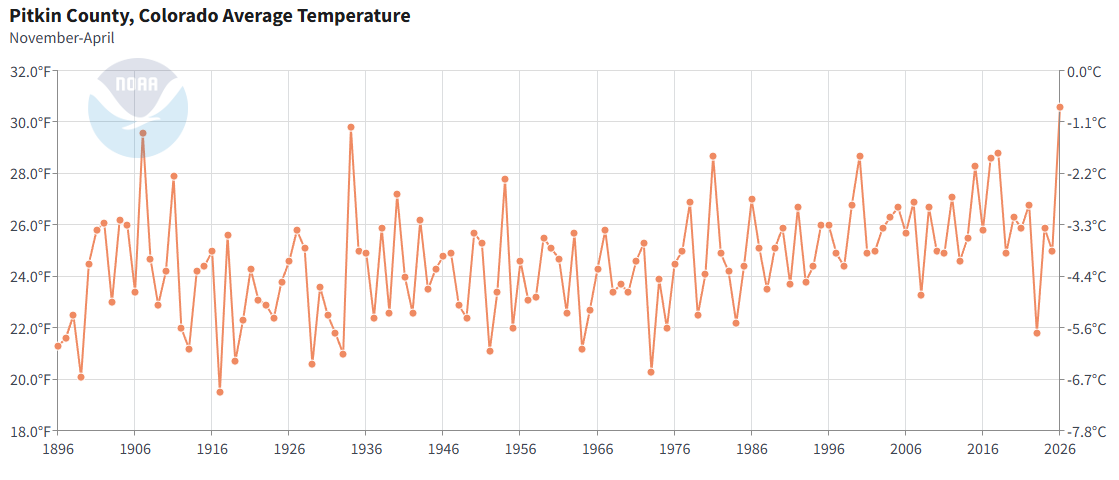
While the precipitation levels over the past year and a half are exceptional, they aren’t enough to account for the unprecedented drought we currently find ourselves in. Based on the Palmer Drought Severity Index (PDSI), a measure of drought that incorporates temperature and precipitation over time to measure dryness, we are in the midst of the most severe drought in 132 years of records. A large portion of this is driven by temperature. Last winter was the warmest on record, and the 2025 summer, while not record-setting, was the 10th warmest. Temperature has taken what would have historically been an extreme precipitation drought and turned it into a record-setting event.
Future Droughts
Precipitation is incredibly variable, and the graphs above show no significant trend in long-term precipitation. In all likelihood, this will be one of the lowest precipitation winters in our lifetimes. Unfortunately, the same can’t be said of temperature. The trend in temperature is very clearly increasing, and we can say with high confidence that many of us and certainly our children will see the temperature record set this winter broken multiple times. While there is year-to-year variation, the science is clear that this trend is a consequence of human-caused climate change. This means that as long as we continue to emit greenhouse gases, we can expect this trend to continue. As temperatures go up, the probability of droughts increases. Even with the same amount of precipitation, if we’re losing moisture to evapotranspiration, that means less water for plants, animals, and people.
Some scientists have started referring to the Millennium Drought as aridification rather than drought. The difference is subtle but important. A drought is temporary — we expect it to end at some point. Aridification, according to the US Geological Survey, is “the transition to persistent above-average dry conditions that do not return to normal.” If the drier conditions we’ve experienced since 2000 are a new normal and not a temporary deficit, we need to take different actions.
Where Do We Go from Here
With any natural hazard, there are things humans can control and manage and there are things that are beyond our control; the same is true with drought. We can take management actions to use water more effectively, but we can’t make more water and we can’t replace the moisture deficit in natural systems.
Responding to aridification requires a different approach than responding to drought. Drought is reducing spending to make it to the next paycheck; aridification is learning how to live with a significantly smaller paycheck. In a world where the Roaring Fork Valley and the rest of the southwestern US are entering a drier period, our thinking needs to focus on long-term solutions. For example, rather than watering our lawns less for one year, we need to reconsider our lawns. For natural systems, we need to focus on protecting as much as we can from development, extraction, and yes even recreation. This means protecting riparian corridors, maintaining instream flows, and expanding the connected habitat wildlife needs to move across the landscape. Protection gives ecosystems and species the time and space they need to adapt or if necessary shift their ranges to keep pace with a changing climate.
But local protection alone can only buy time. Over the long term, we need to address the source of the problem. As a society, we need to dramatically reduce our greenhouse gas emissions. This isn’t something we can accomplish by ourselves; it requires action at a global scale. Fortunately, global action is driven by people and we can be a part of that. As a community, we can push our elected officials at all levels to prioritize addressing climate change. As individuals, we can take actions that reflect our values and priorities. While individual changes alone can’t solve climate change, they shape the culture and politics that will