January 21, 2026
This Squirrel Appreciation Day, Celebrate Marmots!
As the sun glinted off the East River, I sat perched on one of the many rocks strewn across the riverside, patiently awaiting the arrival of a marmot in my scope. Suddenly, one appeared, scurrying over the grassy knolls that made up my field site. She scampered quickly over each hill as I scrambled to keep her in the sight of my scope. It was there, just before I watched her hastily enter a burrow, that I spotted what I had been hoping to see all morning: a marmot pup. With her babies clutched gently in her mouth, the marmot mom dutifully carried her recently born pups from an old burrow to a new one. Something had compelled her to choose a new place to raise her pups for the summer, and I watched, transfixed, as she returned again and again to retrieve pup after pup. After nine trips back and forth, she had successfully settled all her pups into their new home. I reported the exciting news to my field crew and resumed watching the other marmots as they foraged and moved about the field site.
It was late June of 2022, and I was spending my summer at Rocky Mountain Biological Laboratory (RMBL), just outside Crested Butte, working on a long-term project studying yellow-bellied marmots. Having received a National Science Foundation grant, I joined a cohort of college students at RMBL for a summer of field studies, paper writing, and life in the mountains. Little did I know, this summer stint would inspire a love of the mountains, squirrels, and ecological research that I hadn’t known before. Every day brought something new for my Texas-born self to marvel at — snow on the ground in June, mountains rising impossibly high into the sky, a moose wandering through a patch of willows, and, above all, marmots. Prior to arriving in Colorado, I knew nothing of these large, ground-dwelling squirrels. To me, a squirrel was a wily little creature found lurking around the campus Chick-fil-A hoping to get a french fry handout, not a hardy subalpine mammal. The more I learned about these rotund critters, the more fascinated I became.
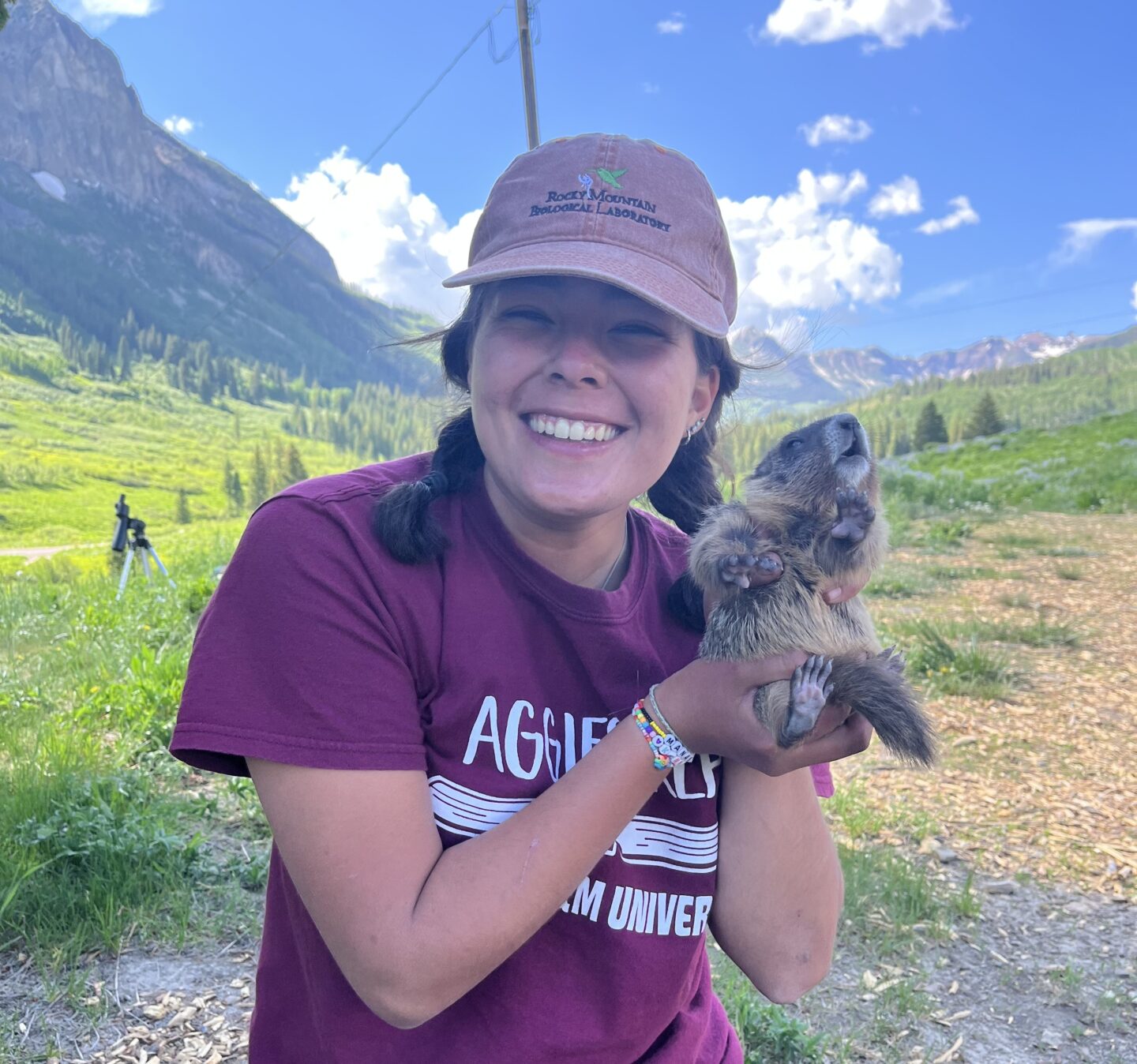
McKenna Sanchez, Summer 2023
Yellow-bellied marmots are Colorado’s largest squirrel, topping out at around 15 pounds and rivaling the size and stature of a small dog. They’re incredibly well-adapted to live in the mountains with dense, golden-brown fur to keep them warm and shortened limbs and ears to prevent heat loss. Yellow-bellied marmots, like other squirrels, are herbivores, feeding primarily on grasses and forbs throughout the summer in order to bulk up for a long hibernation during the harsh winters. While they’re a prevalent sight in wildflower meadows and talus areas in the warm summer months, whistlepigs (and the accompanying high-pitched alarm call for which they are nicknamed) become all but invisible starting in September or October as they retreat into their hibernacula to settle down for a long winter’s nap. In total, marmots will spend over half their lives hibernating.
I enjoyed all the things that accompanied my newfound knowledge of these amazing squirrels. Between the paper-writing process, presentations, field work, and life in the mountains, my summer was rife with learning. I learned how to handle wild animals, communicate my research, and explore the mountains safely – all skills that have stuck with me throughout my time working in the field of ecology.
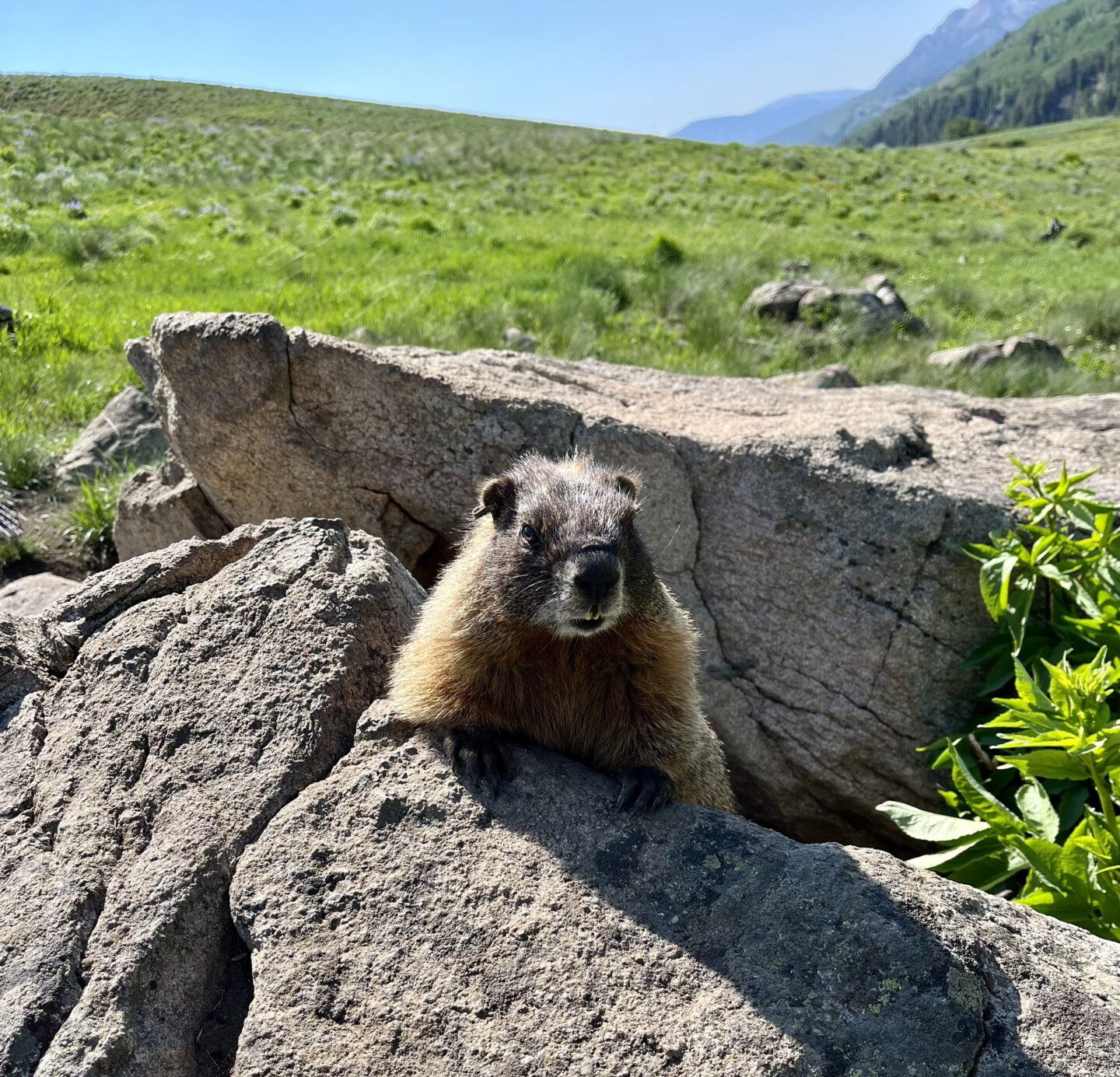
Photo by McKenna Sanchez, Summer 2022
Today, as an ACES Naturalist, I find marmots to be a natural segue into talking about more complex topics such as climate change and habitat loss. As mountain-dwelling animals dependent on cool summer temperatures and a snow-covered ground in winter, marmots are highly susceptible to the effects of climate change. Like with any seasonal animal, the rapidly changing environment we are seeing take hold in our mountains can have detrimental effects on squirrels. Marmots, and squirrels in general, also serve as an opportunity to discuss the validity of ecological research. Wildlife research may appear futile to some, but it is through studying animals out in their natural habitats that we are able to reveal new findings about everything ranging from disease transmission to pollution levels. Whether we are seeking answers about the quality of water, new innovations in cancer research, ways to feed a rapidly expanding world, or a myriad of other topics, wildlife studies contribute to our pool of knowledge immeasurably. By discussing marmots and advocating for ecological research, I hope that others will walk away from my tours feeling inspired to preserve these breathtaking mountains and all the species that call them home.
These days, as I reflect on all the animals and experiences that have shaped me as a naturalist and ecologist, squirrels are undoubtedly at the forefront. They have helped me learn proper field techniques, delve deeper into the world of scientific publishing, and, most importantly, form a stronger connection to the natural world around me. Whether it’s the fox squirrel skittering around your lawn, the pine squirrel chittering at you from the trees that line your favorite trail, or the marmot pup romping around a stunning wildflower meadow, squirrels are all around for us to appreciate. Happy squirrel appreciation day!
~McKenna Sanchez, ACES Naturalist