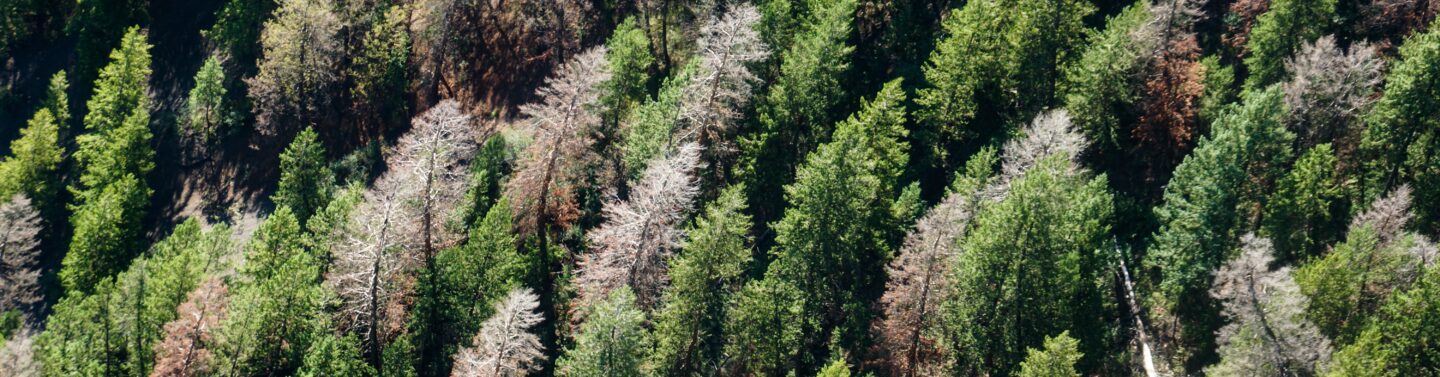
Whether strolling through downtown Aspen, driving up Independence Pass, or visiting Maroon Lake, it’s increasingly obvious something is eating our forest; figuratively and literally. We’re noticing more dying and dead trees dotting the landscape. Those familiar with Colorado have seen this scenario before: it’s played out along the Front Range, I-70, forests surrounding Steamboat, the San Juans, and along the Frying Pan River, among many other areas. But until recently, the upper Roaring Fork Valley has largely been spared. The pest responsible for this damage is none other than our native bark beetles.
What’s Eating Our Forest?

Douglas Fir Beetle – USDA Forest Service – Coeur d’Alene Field Office , Bugwood.org
Local Bark Beetles
Each year bark beetles kill more trees than fire, wind, and disease combined. In Colorado, two major groups of bark beetles impact forests: those in the Ips genus, known as engraver beetles, and those in the Dendroctonus genus, simply referred to as bark beetles. It’s fitting that Dendroctonus beetles carry this straightforward name, as they are responsible for most of the tree mortality caused by bark beetles. Indeed, the Latin root of Dendroctonus translates directly to “tree killer” (dendro meaning tree, and ktonus meaning killer). Long before humans arrived, Dendroctonus beetles had already been shaping Colorado’s forests through periodic outbreaks.
Locally, Dendroctonus beetles infect lodgepole pine, ponderosa pine, pinyon pine, limber pine, blue spruce, Engelmann spruce, and Douglas-fir. Notably absent from this list are subalpine fir and Rocky Mountain juniper, which Dendroctonus beetles never evolved to attack. Currently, much of the activity we’re observing is among Douglas-fir trees, attributed primarily to the Douglas-fir beetle (Dendroctonus pseudotsugae).
Douglas-fir Beetle Ecology
Most Dendroctonus beetles are host-specific, meaning they can only breed successfully in a few select tree species. Douglas-fir beetles are no exception. In the Roaring Fork Valley, their host is exclusively Douglas-fir, typically found in mixed-conifer forests between elevations of 7,000 and 10,500 feet.
Each spring, adult Douglas-fir beetles emerge to search for suitable host trees for reproduction. Female beetles initiate attacks, boring through tree bark and constructing egg galleries beneath. Once a gallery is established, the beetles release aggregation pheromones, attracting males and additional females. After mating, females emit an anti-aggregation pheromone (MCH) to deter additional beetles, thus preventing overcrowding. After roughly two weeks, eggs hatch, and larvae spend the next 2–3 months feeding on the tree’s inner bark. Larvae pupate in late fall, overwintering within the bark as immature adults until spring.
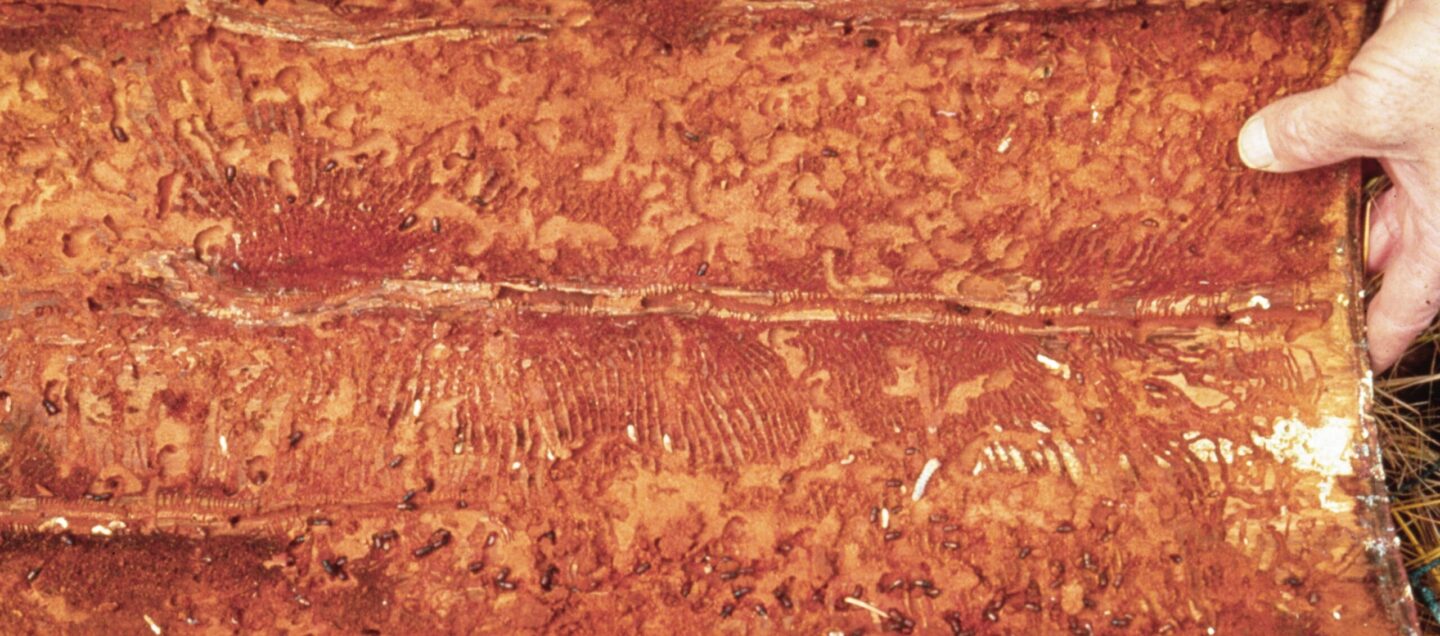
Douglas Fir Beetle Galleries – USDA Forest Service – Forest Health Protection Intermountain Region – Ogden, UT , USDA Forest Service, Bugwood.org
Managing Beetle Outbreaks
Bark beetles, like fire, are a source of natural disturbance integral to Colorado’s forests. However, also like wildfire, human activities—including climate change and fire suppression—have intensified the scale and severity of beetle outbreaks. While broad-scale beetle management across entire forests is neither practical nor desirable, strategic interventions in limited, high-value areas near communities can help mitigate impacts.
In targeted areas (up to several hundred acres), foresters can deploy anti-aggregation pheromones to slow the spread. Yet, at the broader forest scale, this approach quickly becomes cost and labor prohibitive.
Currently, a partnership of local organizations including; ACES, Aspen Fire Protection District, Aspen Skiing Company, Aspen Valley Land Trust, City of Aspen, Colorado State Forest Service, Pitkin County, and the U.S. Forest Service is working collaboratively to manage the ongoing outbreak on Aspen Mountain. While local efforts like this can impact small areas, the broader future of beetle outbreaks remains deeply tied to global climate patterns
The Future Belongs to Beetles
Trees and bark beetles have co-evolved in a relentless evolutionary arms race spanning millions of years. As trees evolve defenses, beetles adapt methods to overcome them. Historically, beetles have thrived during warm and dry periods, conditions that stress trees and weaken their defenses against mass beetle attacks. Today, human-induced climate change is increasing the frequency and severity of these stressful conditions, further tipping the balance in favor of beetles.
Ultimately, our best long-term strategy to minimize future beetle outbreaks is clear: reduce fossil fuel consumption and curtail the human activities driving global warming.